


Successful customer communication today must do more than simply convey information. It thrives on standing out with relevant personalisation and creating experiences that feel truly personal rather than mechanical. ‘Delight your customer’ means exactly that: designing customer experiences that surprise positively, leave a lasting impression and trigger genuine enthusiasm.
Emotionality in the customer experience
Today, it is more important than ever for companies to create a customer experience that is so outstanding that customers consciously decide to enter into a long-term relationship. Emotions play a central role in this: according to Gallup, around 70 percent of all customer decisions are based on emotional factors. Rational criteria such as price or range of functions are thus becoming less important – and will also be increasingly curated, compared and pre-filtered by AI agents in the future. The most effective way to create a customer experience that appeals to customers on an emotional level involves two key elements: personalisation and interactivity.
Personalisation
Customer expectations are constantly growing. That’s why genuine 1:1 personalisation is becoming increasingly important. It’s no longer enough to simply be present. Content must be individual, relevant and precise. Every second of interaction counts.
Personalisation works on different levels:
- Content: Must match interests, create relevance and immediately engage the user.
- Timing: Choose the right moment so that the message can have the optimal effect.
- Context: Choose the appropriate channel through which the user prefers to communicate.
- Presentation: The format, style and form of communication should suit the user.
Interactive emails
Interactive emails are particularly well suited to creating a personalised and relevant experience within the email, based on all known user data – while simultaneously expanding this database.
In a traditional newsletter, not every product is likely to be relevant to every user. In an interactive email newsletter, for example, categories could be selected or a wish list created, thereby increasing relevance for the user through their active participation.
Interactive emails allow you to:
 |
Improve conversions
Interactive content directly in the email promotes impulse buying, reduces bounce rates and increases ROI measurable. |
 |
Reduce costs
The integration of landing pages into emails eliminates the need for external landing pages, reduces printing costs and increases conversion rates. |
 |
Increase engagement
Fewer clicks, no media breaks: interactive emails increase user activity and enable personalised experiences. |
 |
Increase relevance
Relevant content directly in the email ensures maximum attention – without additional tools or technical hurdles. |
 |
Expand your reach
Optimised display for all common systems and providers enables a reach of up to 80% of users. |
 |
Gain data & insights
Zero-party and first-party data can be meaningfully expanded in a GDPR-compliant manner using behaviour-based filters and user profiles. |
Automating enthusiasm
In order to be able to deliver personalised content to customers in real time, companies first need a central database – for example, in the form of a CRM or customer data platform (CDP). This is where customer data is collected, consolidated and prepared for personalisation.
On this basis, automated journeys can be orchestrated in marketing automation or customer engagement platforms, enabling individual, relevant and context-based 1:1 communication. The result is personalised touchpoints along the entire customer journey: every user receives exactly the content that is relevant to them at the right time, in the right context and via the right channel.

Conclusion
Personalisation and interactivity are crucial to truly inspiring customers. Those who manage to provide relevant content at the right time and in the right format create emotional experiences that linger in the memory. Interactive emails, intelligent data processing and automated journeys make it possible to deliver these individual experiences efficiently and scalably.
- Focus on true 1:1 personalisation – content must be individual, relevant and precise
- Use interactive emails to increase engagement, conversion and data quality
- Actively use zero- and first-party data to create personalised experiences in real time
Checklist: 11 best practices for interactive emails
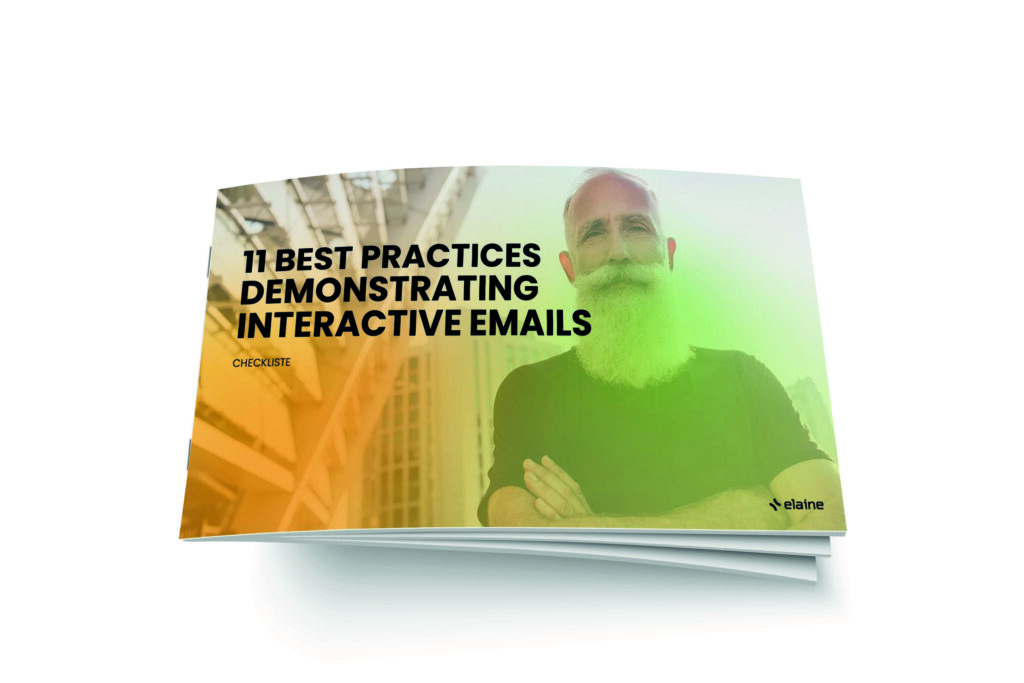
In our checklist “11 best practices for interactive emails”, we and our partner Mayoris present eleven best practices for interactive emails in email marketing.
To download the whitepaper, simply fill out the form.